Human Life Circled by AI: Marketing’s Next Chapter Belongs to People
This is where marketing for humanity begins.

We’re already living in an era where AI is stepping into roles we considered purely human until yesterday. This isn’t just about a tool that writes a text, builds a report, or helps put together a presentation anymore. We’re talking about a new digital environment where AI becomes the thinker, the doer, and, increasingly, the invisible consumer standing behind our choices.
- The thinker, because it thinks alongside us. It analyzes, connects, compares, suggests. It can read in seconds what would take a person hours to study. It can map out scenarios, spot patterns, predict behavior, and push us toward faster decisions.
- The doer, because it executes. It writes, designs, organizes, automates, responds, sorts, produces. From an email to a full campaign, from a shopping list to a customer service flow, AI no longer waits for instructions. It’s taking on more and more of the actual doing.
- And the consumer, this is where the real shift begins. The AI assistant will tell us what to buy, which brand to trust, which product is worth it, which service offers better value, which choice fits our profile. The AI agent will be able to run processes, negotiate, compare vendors, decide on procurement, and organize the needs of companies and people alike.
So marketing will no longer be speaking only to people. It will be speaking to the algorithm standing between people and the market.
And that’s where the critical question sits: in this new era, what comes next for marketing? What’s the human role? And what responsibility does a brand carry toward real human life?
Because let’s be honest. Every AI available to us today was built on serious investment. Behind every tool are companies, capital, targets, business models, growth plans, performance expectations. AI helps us, serves us, frees up our time, opens up possibilities. At the same time, as a product, it needs to grow usage, habit, dependency, sales, subscriptions, revenue.
That’s not necessarily a bad thing. But it’s something we need to see clearly.
Recent digital history has already shown us the pattern. Platforms, social media, marketplaces, apps, recommendation engines. They all started as tools that made our lives easier, faster, more connected. Along the way, plenty of them turned into environments competing for our attention, our time, our behavior, our choices.
AI is going to take that relationship much further. It will be more useful, smarter, more personal, more woven into daily life. And precisely because of that, this era requires far more human awareness.
In a world where algorithms will carry enormous weight in our decisions, we can’t assume that every act of consumption, every brand choice, every recommended product, every automated decision will simply, by default, serve the good of humanity. What’s good for human life doesn’t come built into the code. It takes intentional thinking. It takes ethics. It takes business imagination. It takes brands that know why they exist and how they make that reason a deeper invitation to their world.
This is where marketing for humanity begins
We’re not talking about a nice slogan. Or purpose washing. And definitely not another corporate statement that sounds good in a deck and then disappears in practice. Marketing for humanity is a serious dimension of what a brand actually is. It’s how a brand answers this question: “How do I bring people closer to what they truly need to live better?
And “closer” needs a new definition today.
Closer doesn’t have to mean physically nearby. It can mean closer to my truth. Closer to care. Closer to taste. Closer to freshness. Closer to an honest conversation. Closer to a community. Closer to someone who, in their own way, actually sees me as unique the moment I walk into a store. Closer to a choice that treats me not as a data point, but as a person with a story, a mood, a need, a moment.
None of this means technology should be rejected. Quite the opposite. The brands that move forward will be the ones that embrace technology, bringing it in to support their strategy; in a way that motivates people for something deeper than the buzz of technology: leading them to live the life they desire, shaping the world as they desire.
They’ll use AI to understand better, organize better, serve better, predict better. At the same time, they will be able to slow down and ask: does what we’re doing lead people toward a more “alive” life, or just faster consumption and faster living? This is exactly where small, medium, and large businesses hold more assets than they realize; each for different reasons.
A store, for instance, can be so much more than a point of sale. It can become a place of connection. A place of experience. A place that leaves its mark on humans’ memory. A place where the customer doesn’t just walk in to buy something, but to feel something, to try, to ask, to smell, to taste, to touch, to remember why physical life still matters.
The people working in a store are also an amazing part of the brand’s world. It’s not about smiling mechanically because the manual says so. It’s about bringing something AI genuinely cannot: a real smile, a familiar “I see you,” a human observation, a small detail that shows care. The depth of that value doesn’t automatically show up neatly on a dashboard. But it stays with the customer. It builds trust. It gives people a reason to come back.
Brand purpose as a notion also needs to redefine itself: it is much more visible than most of us think when it’s authentically written versus just another empty phrase from an LLM word chain. Not every brand needs to save the world with grand statements. What every brand needs is to know which truth it serves. Where it’s genuinely strong. What it offers that actually matters. Which part of human life it makes a little better, a little easier, a little more beautiful, a little more connected.
That’s where marketing plans with real substance start; not from “what are we posting this week,” but from “what do we want this brand to remind people of?” Do we want to lead them back to flavor? To freshness? To feeling? To connection with the person next to them? To the value of spontaneity? To the joy of choice? To trust in a person? To the pleasure of a moment that doesn’t need to be optimized to be worth having?
These are the new brand assets
And they carry real value precisely because we’re entering an era in which so much will become automated, predictive, and algorithmic. The more AI takes over thinking, execution, and decision-making, the more brands will need to prove their contribution in human living.
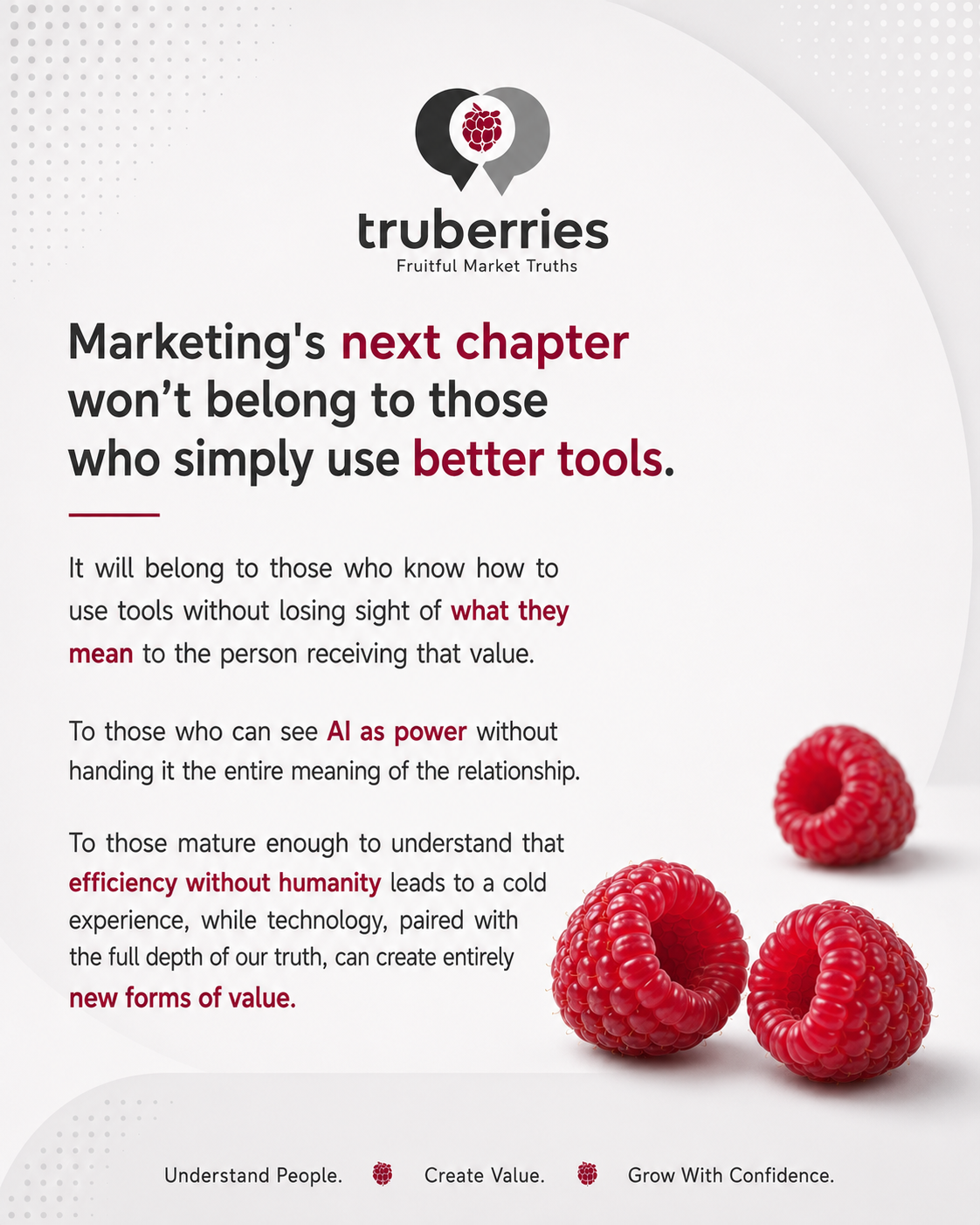
Marketing’s next chapter won’t belong to those who simply use better tools. It will belong to those who know how to use tools without losing sight of what they mean to the person receiving that value. To those who can see AI as power without handing it the entire meaning of the relationship. To those mature enough to understand that efficiency without humanity leads to a cold experience, while technology, paired with the full depth of our truth, can create entirely new forms of value.
Because in the end, people won’t just need smarter recommendations. They’ll need paths to trust. Reasons to feel. Enjoyable choices, with both heart and mind. Reasons to leave the house, walk into a store, talk to another person, try something new, and feel that a brand actually sees them.
This is marketing for humanity
Use technology boldly. See the market with clarity. Recognize the power of data. And then come back to the question that matters most: how does what we do help people live closer to their real, true life?
That’s where the brands of the next era will be judged.
Not just by how visible they are to algorithms. But by how essential they remain to people.
Human Life Circled by AI: Η Επόμενη Μέρα του Marketing Είναι για τους Ανθρώπους
Ζούμε ήδη την εποχή όπου το AI αρχίζει να παίρνει θέσεις που μέχρι χθες θεωρούσαμε καθαρά ανθρώπινες. Δεν μιλάμε πια μόνο για ένα εργαλείο που γράφει ένα κείμενο, φτιάχνει ένα report ή βοηθά σε μια παρουσίαση. Μιλάμε για ένα νέο ψηφιακό περιβάλλον όπου το AI γίνεται ο thinker, ο doer και, όλο και περισσότερο, ο αόρατος καταναλωτής πίσω από τις επιλογές μας.
Ο thinker, γιατί σκέφτεται μαζί μας. Αναλύει, συνδυάζει, συγκρίνει, προτείνει. Μπορεί να διαβάσει σε λίγα δευτερόλεπτα όσα ένας άνθρωπος θα ήθελε ώρες για να μελετήσει. Μπορεί να δώσει σενάρια, να εντοπίσει μοτίβα, να προβλέψει συμπεριφορές και να μας οδηγήσει σε πιο γρήγορες αποφάσεις.
Ο doer, γιατί εκτελεί. Γράφει, σχεδιάζει, οργανώνει, αυτοματοποιεί, απαντά, ταξινομεί, παράγει. Από ένα email μέχρι μια καμπάνια, από ένα shopping list μέχρι ένα customer service flow, το AI δεν περιμένει απλώς οδηγίες. Αναλαμβάνει όλο και περισσότερα κομμάτια της πράξης.
Και ο Ο καταναλωτής – εδώ είναι που συμβαίνει η μεγαλύτερη ανατροπή. Ο AI assistant θα προτείνει τι να αγοράσουμε, ποια μάρκα να εμπιστευτούμε, ποιο προϊόν αξίζει υπό το συγκεκριμένο πρίσμα που θέτει ο υποψήφιος αγοραστής, ποια επιλογή ταιριάζει στο προφίλ του. Ο AI Agent θα εκπαιδεύεται (και ήδη το κάνει, για όλο και περισσότερα άτομα) να τρέχει ή και να διοικεί διαδικασίες, να διαπραγματεύεται αντ΄αυτών ή δι΄αυτών, να συγκρίνει προσφορές, μοντέλα, τεχνικά χαρακτηριστικά ή και reviews, να αποφασίζει προμήθειες σε ποσότητα ή mix, να οργανώνει ανάγκες εταιρειών και ανθρώπων.
Άρα, το marketing που θα πρέπει να σχεδιάζουν οι εταιρίες και οι μάρκες δεν θα μιλά μόνο προς τους ανθρώπους. Θα μιλά και προς τους αλγόριθμους που στέκονται ως βοηθοί-μεσολαβητές ανάμεσα στον άνθρωπο και στην αγορά.
Και εδώ βρίσκεται το κρίσιμο ερώτημα: σε αυτή την εποχή, ποια είναι η επόμενη μέρα του marketing; Ποιος είναι ο ρόλος του ανθρώπου; Και ποια ευθύνη έχει μια μάρκα απέναντι στην πραγματική ανθρώπινη ζωή;
Γιατί ας είμαστε ειλικρινείς. Κάθε εργαλείο AI που μας προσφέρεται σήμερα έχει δημιουργηθεί μέσα από μια σοβαρή επένδυση. Πίσω από κάθε τέτοια επένδυση υπάρχουν εταιρείες, έχουν μπει κεφάλαια, στόχοι, business models, growth plans, προσδοκίες απόδοσης. Το AI μάς βοηθά, μας εξυπηρετεί, μας απελευθερώνει χρόνο, μας ανοίγει δυνατότητες. Πρωτίστως όμως είναι προϊόν και ως προϊόν χρειάζεται να αυξάνει τους χρήστες και τις ώρες χρήσης, με το να χτίζει συνήθεια ή και εξάρτηση κι έτσι να επιτυγχάνει περισσότερες πωλήσεις.
Αυτό δεν είναι απαραίτητα κακό. Είναι όμως κάτι που χρειάζεται να θυμόμαστε και να συνυπολογίζουμε.
Η ψηφιοποίηση της ζωής μας τα τελευταία χρόνια μάς έχει ήδη δείξει το μοτίβο. Platforms, social media, marketplaces, apps, recommendation engines. Όλα ξεκίνησαν ως μικροί θαυματοποιοί – εργαλεία που έκαναν τη ζωή μας πιο εύκολη, πιο γρήγορη, πιο συνδεδεμένη. Στην πορεία, αρκετά από αυτά έγιναν περιβάλλοντα ζωής όπου αφενός περνάμε χρόνο και αφετέρου διεκδικούν την προσοχή μας, τον χρόνο μας, τη συμπεριφορά μας και το χρήμα μας.
Το AI θα πάει αυτή τη σχέση πολύ πιο μακριά. Θα είναι πιο χρήσιμο, πιο έξυπνο, πιο προσωπικό, πιο ενσωματωμένο στην καθημερινότητα. Και ακριβώς γι’ αυτό χρειάζεται περισσότερη επίγνωση.
Σε έναν κόσμο όπου οι αλγόριθμοι θα έχουν τεράστια επιρροή στις αποφάσεις μας, δεν μπορούμε να θεωρούμε δεδομένο ότι κάθε πράξη κατανάλωσης, κάθε επιλογή μάρκας, κάθε προτεινόμενο προϊόν ή κάθε αυτοματοποιημένη απόφαση θα λειτουργεί a priori για το καλό της ανθρωπότητας. Το καλό για τον άνθρωπο και το μέλλον του δεν μπαίνει προκαταβολικά μέσα στον κώδικα.
Χρειάζεται συνειδητή εγρήγορση των ανθρώπων ως χρήστες, νέα αξιακή και ηθική ματιά για να διασφαλίσουμε ποιοτική ζωή. Και οι μάρκες, χρειάζεται να ενδιαφερθούν με αυθεντικό τρόπο για όλα τα παραπάνω, απαιτείται νέα κατεύθυνση περιέργειας και φαντασίας ως αναπόσπαστες ιδιότητες της επιχειρηματικής ανάπτυξης. Χρειάζονται μάρκες που νοιάζονται με τον τρόπο ποτ πρεσβεύουν το καλό, και αυτό προϋποθέτει να ξέρουν γιατί υπάρχουν.
Εδώ αρχίζει το marketing for the humanity
Δεν μιλάμε απλά για ένα ωραίο tagline. Ούτε για purpose washing. Και σίγουρα όχι για ακόμα ένα corporate statement που ακούγεται καλό σε μια παρουσίαση και η πράξη το διαψεύδει. Το marketing for the humanity είναι μια νέα, ιδιαίτερη διάσταση της ουσίας μιας μάρκας. Είναι ο τρόπος με τον οποίο μια μάρκα απαντά στο ερώτημα: πώς φέρνω τους ανθρώπους πιο κοντά σε αυτό που χρειάζονται πραγματικά για να ζήσουν καλύτερα;
Και το “κοντά” σήμερα χρειάζεται να επαναπροσδιοριστεί.
Κοντά δεν σημαίνει απαραίτητα δίπλα-δίπλα με τον τρόπο της φυσικής παρουσίας. Μπορεί να σημαίνει πιο κοντά στην αλήθεια που δίνει νόημα στον πελάτη. Πιο κοντά στη φροντίδα που δεν έχει συνειδητοποιήσει ότι χρειάζεται αλλά τον βοηθάς να ανακαλύψει. Πιο κοντά στη γεύση που τον ξεσηκώνει. Πιο κοντά στη φρεσκάδα που του λείπει. Πιο κοντά σε μια συνομιλία με τον πωλητή, όπου το νιάξιμο και το χαμόγελο είναι γνήσιο. Πιο κοντά σε μια κοινότητα που γεμίζει τον καταναλωτή σας ευτυχία και μόνο η σκέψη ότι υπάρχει. Πιο κοντά σε μια επιλογή που δεν μας αντιμετωπίζει ως data point, αλλά ως ζωντανά ανθρώπινα όντα με παρελθόν, με προσωπικότητα, με διαφορετικότητα, με επιθυμίες που μπορούν να είναι εντελώς άλλες ανά διάθεση, ανάγκη και στιγμή.
Όλα αυτά δεν σημαίνουν ότι η τεχνολογία είναι εχθρός. Οι μάρκες που θα προχωρήσουν θα είναι αυτές που θα αξιοποιήσουν την τεχνολογία στο έπακρο, ενώ ταυτόχρονα θα επανεφεύρουν την ανθρώπινη μετα-αξία τους. Θα χρησιμοποιούν AI για να καταλαβαίνουν καλύτερα, να οργανώνονται καλύτερα, να εξυπηρετούν καλύτερα, να προβλέπουν καλύτερα. Αλλά θα ξέρουν ότι το φανάρι δεν είναι πάντα πράσινο. Θα βλέπουν μέσα τους αναγνωρίζοντας τις δικές τους προθέσεις και στρατηγική ως πρώτιστη προτεραιότητα, κι όταν αυτή «ανάβει κόκκινο» θα σταματούν για λίγο για να αναρωτηθούν: οδηγεί όντως αυτό που κάνουμε οδηγεί τους ανθρώπους σε ζωή που να αξίζει πιο πολύ να ζήσεις ή απλώς σε πιο γρήγορη ζωή και κατανάλωση;
Ως προς αυτό το πρίσμα, τόσο οι μικρές, όσο και οι μεσαίες ή οι μεγάλες επιχειρήσεις έχουν περισσότερα assets από όσα νομίζουν, κάθε τύπος για άλλους λόγους.
Μία μάρκα που διαθέτει καταστήματα, για παράδειγμα, μπορεί να τα αναδείξει σε πολύ περισσότερα από σημείο πώλησης. Μπορεί να γίνει χώρος «όπου κάτι όμορφο συμβαίνει». Χώρος νέων εμπειριών που δεν περίμενες. Χώρος όπου ο πελάτης δεν μπαίνει απλώς για να αγοράσει κάτι, αλλά για να νιώσει κάτι. Να δοκιμάσει, να ρωτήσει, να μυρίσει, να γευτεί, να αγγίξει. Να θυμηθεί το γιατί η φυσική ζωή έχει αξία, γιατί το σώμα δεν είναι κάτι που κουβαλάει το avatar μας, αλλά αντίθετα, το avatar μας είναι μόνο ένα μέρος της ύπαρξής μας.
Οι εργαζόμενοι σε ένα κατάστημα είναι επίσης τεράστιο asset. Το θέμα δεν είναι αν χαμογελούν μηχανικά σύμφωνα με το manual. Είναι αν μπορούν να φέρουν στη στιγμή των επισκεπτών κάτι που το AI δεν μπορεί να κάνει: ένα αυθεντικό χαμόγελο, μια γνώριμη ως ανθρώπινη έκφραση που δημιουργεί όση οικειότητα χαλαρώνει και αναβαθμίζει την επίσκεψη, μια μικρή συμβουλή – λεπτομέρεια που δείχνει φροντίδα. Το βάθος αυτής της αξίας μπορεί να μην μετριέται αυτοματοποιημένα στο γράφημα πάνω στο dashboard. Μένει όμως στον πελάτη. Ανατροφοδοτεί την εμπιστοσύνη και πιθανά να κάνει τον πελάτη να ξαναέρθει όσο τίποτε άλλο δεν μπορεί να κάνει.
Το brand purpose χρειάζεται επίσης να επαναπροσδιορίσει τον εαυτό του, γίνεται εύκολα πλέον αισθητό το αν είναι όντως αυθεντικά γραμμένο κι αν ταιριάζει στην αλήθεια της μάρκας. Δεν είναι όλες οι μάρκες για να σώσουν τον κόσμο με φαμφαρώδεις δηλώσεις. Όμως αν η μάρκα ξέρει ποια αλήθεια τελικά κάνει τον κόσμο να ζήσει, πού είναι πραγματικά δυνατή, τι προσφέρει που έχει όντως νόημα, ποια πλευρά της ανθρώπινης ζωής κάνει λίγο καλύτερη, λίγο πιο εύκολη, λίγο πιο όμορφη, λίγο πιο συνδεδεμένη, τότε έχει δυνατότητα να πει πιο ενδιαφέρουσες ιστορίες.
Από εκεί ξεκινούν τα marketing plans που φέρνουν αποτέλεσμα. Αντί να αρχίζουν από το “τι θα ποστάρουμε αυτή την εβδομάδα”, ξεκινούν από το “τι θέλουμε να ξαναθυμίζει αυτή η μάρκα στους ανθρώπους σήμερα;”. Τη σύνδεση με τον διπλανό τους; Την αξία του αυθορμητισμού; Τη χαρά της επιλογής; Την εμπιστοσύνη σε ένα πρόσωπο; Την απόλαυση μιας στιγμής που δεν χρειάζεται να γίνει τέλεια για να αξίζει;
Αυτά είναι τα νέα brand assets
Και έχουν μεγάλη αξία, ακριβώς επειδή μπαίνουμε σε μια εποχή όπου πάρα πολλά πράγματα θα γίνουν αυτοματοποιημένα, προβλέψιμα, αλγοριθμικά κατασκευάσματα. Όσο πιο πολύ το AI θα αναλαμβάνει τη σκέψη, την εκτέλεση και την απόφαση, τόσο πιο πολύ οι μάρκες θα χρειάζεται να αποδείξουν τη συνεισφορά τους σε μία ανθρώπινη ζωή που αξίζει.
Η επόμενη μέρα του marketing δεν θα ανήκει σε όσους απλά χρησιμοποιούν πιο σύγχρονα εργαλεία. Θα έρθει για όσους ξέρουν να χρησιμοποιούν τα εργαλεία χωρίς να αγνοούν το τι αξία τελικά χτίζουν στον παραλήπτη της αξίας τους, τον άνθρωπο. Σε όσους μπορούν να δουν το AI ως δύναμη, χωρίς να «το υπερχρεώνουν» με όλη την ευθύνη της σχέσης. Σε όσους έχουν την ωριμότητα να καταλάβουν ότι η αποτελεσματικότητα θα ενέχει από δω και στο εξής την ανθρωποκεντρικότητα, αλλιώς θα οδηγεί γρήγορα και ωμά σε κρύες, αδιάφορες, κοινότυπες εμπειρίες.
Γιατί στο τέλος, ο άνθρωπος δεν θα χρειάζεται μόνο πιο έξυπνες προτάσεις. Θα χρειάζεται τη σπίθα που τον κάνει να λάμπει γιατί μπορεί να εμπιστεύεται κι επειδή αυτή η εμπιστοσύνη αξίζει.
Αυτό είναι το marketing for the humanity
Να αξιοποιείς την τεχνολογία με τόλμη. Να βλέπεις την αγορά με καθαρότητα. Να αναγνωρίζεις την ψυχή των δεδομένων. Και μετά να επιστρέφεις στην πιο σημαντική ερώτηση: πώς αυτό που κάνουμε βοηθά τελικά τους ανθρώπους να ζήσουν πιο κοντά και πιο πολύ από την αληθινή ζωή;
Εκεί θα κριθούν οι μάρκες της επόμενης εποχής.
Όχι μόνο στο πόσο ορατές είναι στους αλγόριθμους και άρα στον κόσμο. Αλλά στο πόσο ουσιαστική τελικά καταφέρνουν να κάνουν αυτή την ορατότητα για τις ζωές των ανθρώπων.